
Children’s Eye Tests: What Australian Parents Should Know
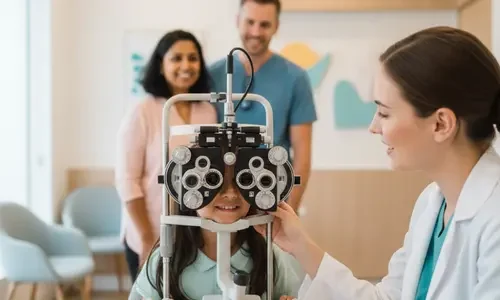
In Australia, 80% of what a child learns at school is processed through their eyes. Yet, vision problems often go unnoticed because children don’t know that what they are seeing isn't "normal." They don't complain of blurriness—they simply struggle to keep up.
Whether your child is a toddler reaching developmental milestones or a "preppie" starting their first year of school, understanding the timing and signs of vision issues is one of the most important parts of your parenting toolkit.
Quick Summary: The Australian Eye Care Checklist (Featured Snippet)
If you’re looking for the essentials of pediatric eye health in Australia, here is what you need to know:
The Milestones: Optometrist recommends comprehensive eye exams at 6 months, 3 years, and before starting school (age 4–5).
The Cost: Most standard children’s eye tests are bulk billed via Medicare, meaning no out-of-pocket costs for eligible families at participating optometrists.
The Difference: A school "vision screening" is not a full eye test. It only checks distance vision and often misses issues like long-sightedness or eye health problems.
Red Flags: Watch for physical signs (squinting, eye rubbing) and behavioral clues (avoiding reading, short attention span, or tilting the head).
Why Early Detection is Vital
The human visual system isn't fully developed at birth. It matures rapidly in the first seven to eight years. If a condition like Amblyopia (Lazy Eye) or Strabismus (Crossed Eyes/Squint) isn't caught during this "critical period," the brain may never learn to see clearly out of the affected eye, leading to permanent vision loss.
Early intervention ensures that refractive errors—like Myopia (short-sightedness), Hyperopia (long-sightedness), and Astigmatism—are corrected before they impact your child's confidence and academic performance.
When to Book: The Australian Timeline
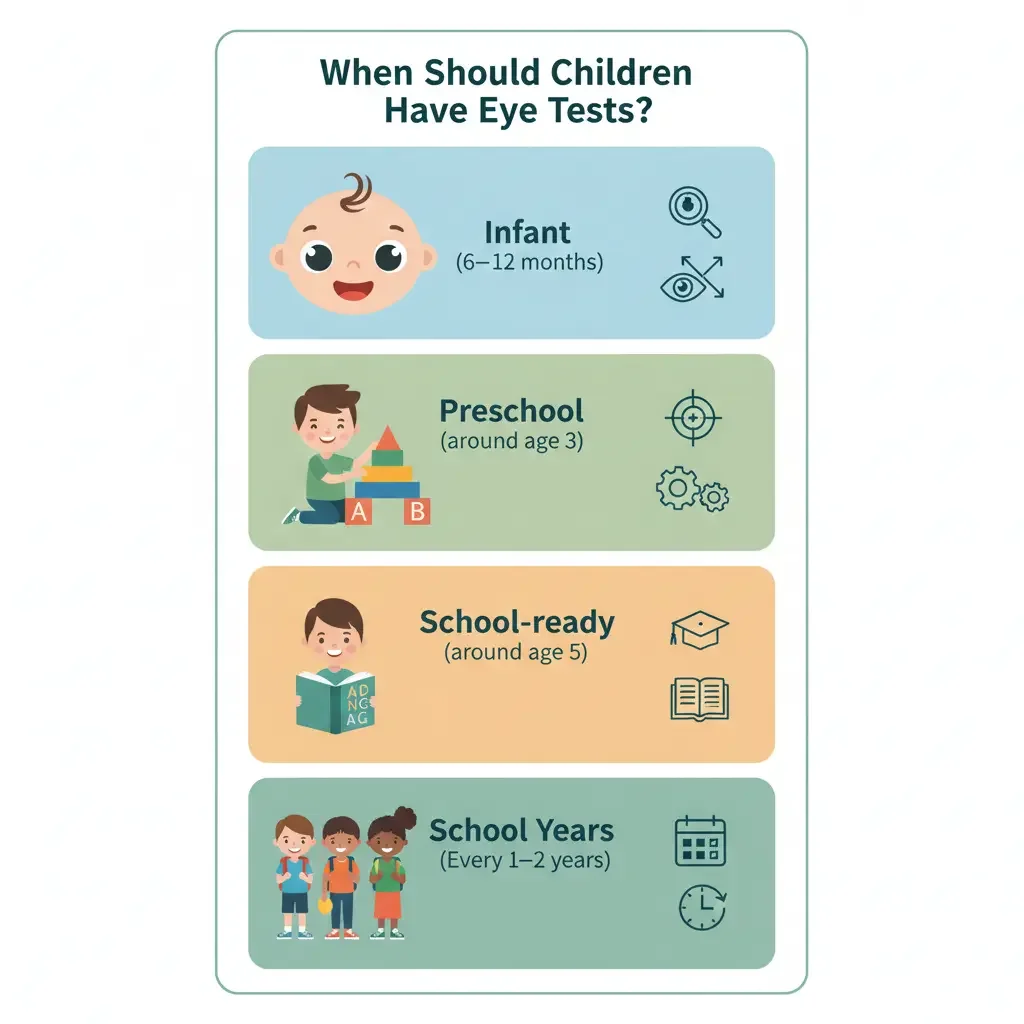
While many states offer a "Statewide Eyesight Preschooler Screening" (like StEPS in NSW), these are basic checks. For a deep dive into your child's eye health, follow this schedule:
1. The Baby Check (6–12 Months)
An optometrist checks that the eyes are aligned, tracking objects correctly, and reacting to light. This is crucial if there is a family history of eye turns or "thick glasses."
2. The Pre-School Check (Age 3)
As toddlers start focusing on finer details (puzzles, drawing), we check for Convergence Insufficiency—the ability of the eyes to work together as a team.
3. The School-Ready Test (Age 4–5)
Before the first day of Prep/Kindergarten, a comprehensive exam ensures they can see the whiteboard and the book in front of them without strain.
4. Ongoing Care (Every 2 Years)
Unless your optometrist recommends more frequent visits (e.g., for kids who already wear glasses), a biennial check is the standard in Australia.
The Red Flags: Signs Your Child Needs a Test Now
Children are masters of compensation. They might tilt their head to use their "good" eye or sit closer to the TV to overcome blur. Watch for these indicators:
Physical Signs: Squinting, frequent eye rubbing, excessive blinking, or one eye appearing to drift (strabismus).
Academic Clues: Losing their place while reading, skipping lines, or using a finger to track words long after their peers have stopped.
Complaints: Frequent headaches (especially after school), eye strain, or sensitivity to light.
Behavioral Shifts: Avoiding near-work (like Lego or coloring) or a suddenly short attention span during reading tasks.
Common Conditions Explained
Myopia (Short-sightedness): Difficulty seeing things far away (the whiteboard or the TV).
Hyperopia (Long-sightedness): Distance vision is okay, but close-up work causes significant strain and "aching" eyes.
Astigmatism: An irregular curve in the eye that makes vision blurry or wavy at all distances.
Color Vision Deficiency: Often called "color blindness," this is usually hereditary. Detecting it early helps teachers adjust classroom materials.
Modern Challenges: Screen Time & Myopia Management
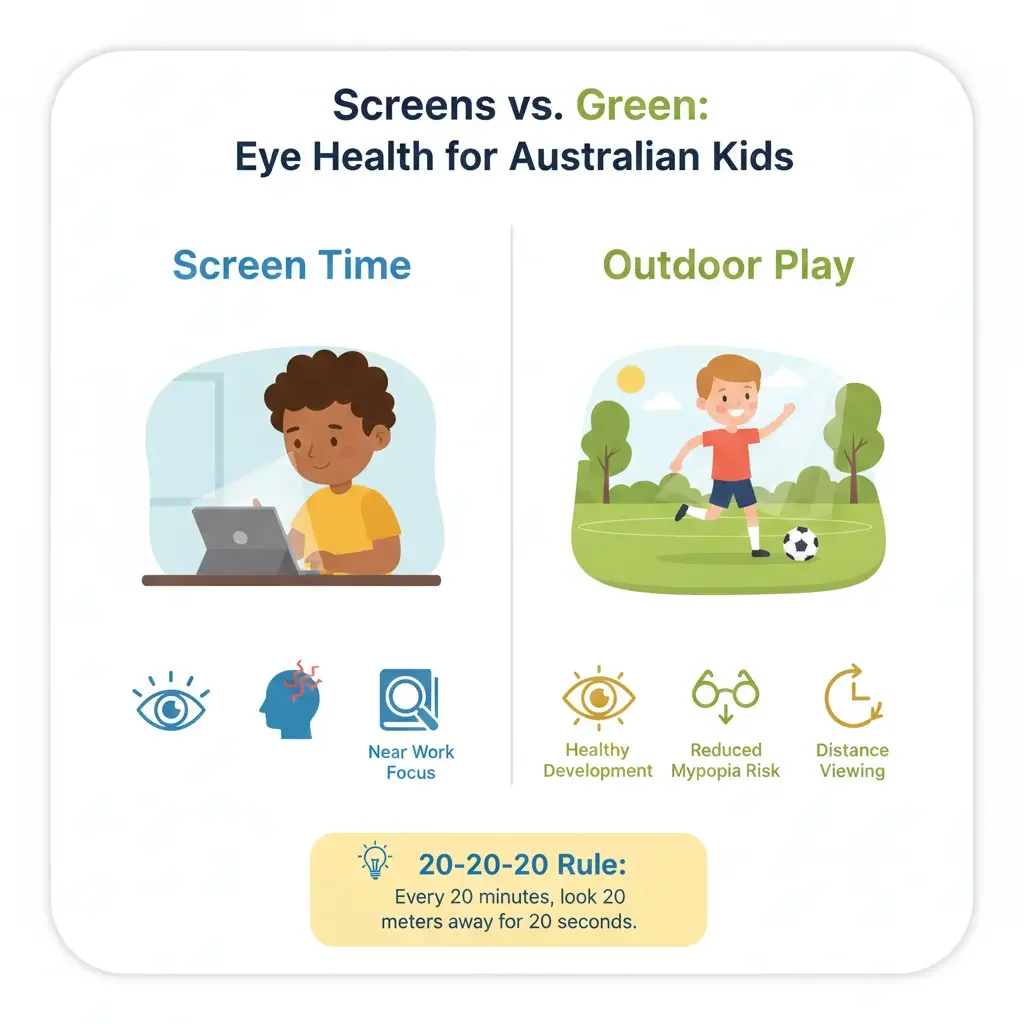
Australia is seeing a significant rise in Myopia due to increased screen time and less time spent outdoors.
The 20-20-20 Rule
To combat Digital Eye Strain, teach your child to look 20 feet (6 metres) away for 20 seconds every 20 minutes of screen use.
Myopia Control
If your child is diagnosed with short-sightedness, ask your optometrist about Myopia Management. Modern treatments—such as specialized Misight lenses, Ortho-K (overnight lenses), or low-dose Atropine drops—can actually slow down the progression of myopia, reducing the risk of serious eye disease later in life.
FAQs:
1. Is a pediatric eye test covered by Medicare?
Yes. In Australia, most optometrists bulk bill standard children's eye exams. You will generally only pay for frames, lenses, or highly specialized scans (like OCT or retinal imaging) if they aren't covered under the standard Medicare schedule.
2. What is the difference between an Optometrist and an Ophthalmologist?
An Optometrist is your primary care provider for vision tests, glasses, and general health checks. An Ophthalmologist is a medical doctor and eye surgeon who treats complex diseases and performs surgery. You usually need a referral from your GP or optometrist to see one.
3. My child can't read yet—how can they do an eye test?
Optometrists use LEA symbols (shapes like houses, apples, and squares) or picture-based charts for toddlers. They can also use lights and lenses to measure a child's prescription objectively without the child needing to say a word.
4. Can children wear contact lenses?
Yes. Many Australian children use contact lenses for sports or as part of a myopia control program. Maturity and hygiene are more important than age; many kids start as young as 8 or 9.
5. Does my child need blue light glasses?
While blue light from screens can disrupt sleep, the best protection for children's eyes is taking regular breaks (the 20-20-20 rule) and ensuring they get at least 2 hours of outdoor play daily.
Ready to book?
Go beyond the school screening—book a comprehensive eye test with a trusted local optometrist and give your child the clear vision they deserve.
Find a local independent Australian Optometrist near you at LocalEyez
