
Are Online Eye Tests Accurate? What Australians Should Know
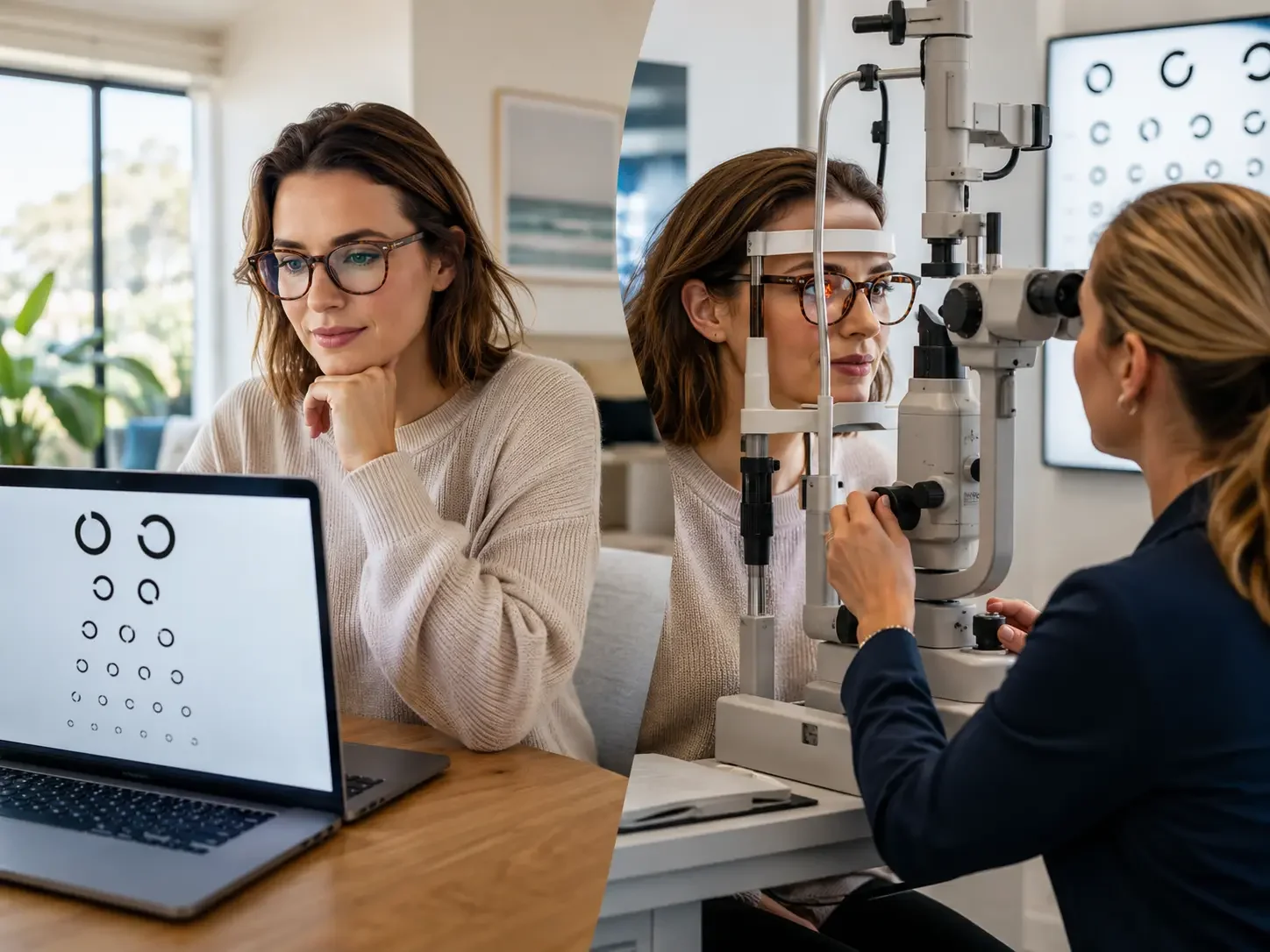
Online eye tests can be useful for checking visual acuity and identifying whether you may need further eye care, but they are not a substitute for a comprehensive eye examination with an optometrist. Research shows that some validated at-home visual-acuity tests can produce results close to clinic-based measurements under controlled conditions. However, online tests generally cannot provide the full range of clinical assessments needed to evaluate eye health, detect many eye diseases or determine the most appropriate prescription with the same level of confidence as an in-person examination.
Are Online Eye Tests Accurate?
The short answer is: sometimes, but only for what they are designed to measure.
An online eye test can be a convenient first step if you want to check whether your distance or near vision has changed. Some digital tests measure visual acuity using letters, symbols or other targets displayed on a smartphone, tablet or computer.
But there is an important distinction between an online vision screening and a comprehensive eye examination.
A screening may tell you that your vision appears reduced or that you may benefit from professional assessment. A comprehensive examination goes much further. An Australian optometrist can assess your vision, eye health and refractive needs and screen for potentially serious conditions. Healthdirect recommends regular eye tests even when you have no obvious symptoms.
So, if you're searching "are online eye tests accurate?", the best answer is:
They can be reasonably accurate for visual-acuity screening when properly designed and performed, but they should not be treated as a complete eye health examination.
What Does an Online Eye Test Actually Measure?
Not every online eye test does the same thing.
Depending on the platform, an online test may assess:
Distance visual acuity
Near visual acuity
Basic colour vision
Reading ability
Whether one eye sees differently from the other
Possible changes in your vision
Whether you may need a professional eye examination
Some tests are little more than digital versions of a traditional eye chart, while more sophisticated systems use automatic distance calibration, adaptive testing or smartphone technology.
Research into digital visual-acuity testing is encouraging. A 2022 JAMA Ophthalmology study involving 121 participants compared three at-home tests — a printed chart, smartphone app and website — with standard clinical measurements. All three were within approximately one line of the clinic measurement on average.
However, this does not mean every website-based eye test is equally reliable.
The quality of the technology, screen, testing distance, lighting and instructions all matter.
Online Eye Test vs Professional Eye Test: What's the Difference?
This is one of the most important points that many online articles fail to explain clearly.
| Online Vision Test | Professional Eye Examination |
|---|---|
| Usually measures visual acuity | Measures visual acuity plus broader visual and eye-health factors |
| Performed using your own device | Uses calibrated clinical equipment |
| Results can be affected by screen size and distance | Testing conditions are controlled |
| Convenient for preliminary screening | Provides a comprehensive clinical assessment |
| May identify possible vision problems | Can investigate the underlying cause |
| Usually cannot examine the internal structures of the eye | Can include examination of the retina, optic nerve and other structures |
| May help monitor changes | Allows an optometrist to interpret changes clinically |
| Not suitable for diagnosing many eye diseases | Can screen for signs of eye disease and refer when necessary |
Healthdirect explains that optometrists perform several different types of tests during an eye examination and can help identify eye problems early.
This distinction is particularly important because good vision does not always mean healthy eyes.
Some eye conditions can develop with few or no noticeable symptoms.
Can an Online Eye Test Detect Eye Diseases?
Generally, you should not rely on a basic online vision test to rule out eye disease.
A simple digital eye chart cannot look inside your eye.
An in-person examination may involve assessments of areas and functions that a basic online test cannot properly reproduce, including:
Eye health
Retina
Optic nerve
Eye pressure where clinically indicated
Binocular vision
Eye movements
Refraction
Accommodation and near vision
Colour vision
Peripheral vision
Signs associated with systemic disease
Optometrists are trained to screen for serious eye conditions and can refer patients to an ophthalmologist when specialist medical management is required.
This is why passing an online vision test should never be interpreted as "my eyes are completely healthy."
Can an Online Eye Test Give You an Accurate Glasses Prescription?
This is where consumers need to be particularly careful.
Visual acuity is only one part of determining the right prescription.
A glasses prescription may involve measurements for:
Sphere
Cylinder
Axis
Near addition for multifocal prescriptions
Different powers for each eye
Other clinically relevant findings
An online visual-acuity chart may tell you that you are struggling to see clearly, but that doesn't automatically tell you exactly why.
For example, blurred vision may be associated with refractive error, astigmatism, presbyopia or other eye problems. Healthdirect notes that astigmatism is diagnosed through an eye examination, while standard vision screening may not identify some forms of long-sightedness reliably.
What about buying glasses online?
If you already have a current, professionally determined prescription, an online vision test may be useful as a quick check to see whether your vision appears to have changed.
But if you're experiencing new symptoms or think your prescription has changed significantly, it is safer to have a professional examination rather than relying on an online result.
In Australia, Medicare's optometry rules also recognise the importance of a professional consultation. Under the Medicare Benefits Schedule, comprehensive optometry services are covered under specific eligibility and frequency requirements.
What Does Research Say About Online Eye Test Accuracy?
The technology is not simply a gimmick. There is genuine research showing that appropriately designed digital tests can measure visual acuity effectively.
Case Study 1: At-Home Vision Testing Compared With Clinic Testing
A JAMA Ophthalmology study published in 2022 evaluated three at-home visual-acuity tests against standard in-office measurements.
The study included 121 participants recruited from comprehensive, cornea, glaucoma and retina clinics.
Participants completed an at-home test using either a printed chart, mobile app or website before their clinic appointment.
The researchers found that all three at-home approaches produced results comparable to clinic testing, generally within one line of Snellen acuity.
What this means for Australians: a properly designed home vision test can be useful for monitoring visual acuity or deciding whether further care may be needed.
What it does not mean: every online eye test can replace an optometrist examination.
Read the full JAMA Ophthalmology study
Case Study 2: Smartphone Testing in Real-World Conditions
Research published in the British Journal of Ophthalmology evaluated WHOeyes, a smartphone-based visual-acuity test that included automatic distance calibration.
The study found good agreement between WHOeyes and standard ETDRS testing for both distance and near visual acuity. Test-retest reliability was also high.
The automatic distance-calibration feature is significant because testing distance is one of the biggest practical problems with home eye charts.
A person sitting too close to a laptop or holding a phone at the wrong distance can obtain a misleading result.
Read the WHOeyes research study
Case Study 3: Online Vision Testing in Children
A 2026 study evaluated a custom iPhone application for measuring visual acuity at home in 452 children aged 3 to 17.5 years.
For eyes with relatively good visual acuity, the home app showed strong agreement with standard clinical testing. However, agreement became considerably weaker in eyes with poorer vision.
This is an important finding for parents.
A digital test can be useful as a screening tool, but children should not be considered cleared simply because they pass an online test.
Healthdirect recommends full eye examinations for children before starting school and regular checks during school years.
Read the 2026 paediatric validation study
Why Can Online Eye Test Results Be Wrong?
Even a scientifically validated test can produce a less reliable result if it is performed incorrectly.
1. Screen size
A letter displayed on a large desktop monitor is not necessarily the same physical size as the letter displayed on a smartphone.
2. Viewing distance
If the instructions require you to sit one metre away but you sit significantly closer, the result can change.
3. Screen brightness
Research has specifically examined how screen brightness and device type affect online visual-acuity measurements. One 2023 study found differences between tested conditions were relatively small in that particular setup, but this still demonstrates why device and testing conditions matter.
4. Lighting and glare
Bright reflections, dark rooms or sunlight hitting the screen can make letters harder to distinguish.
5. Incorrect calibration
Some tests depend on correctly identifying the physical size of the screen or using a calibration process.
6. Testing with glasses
Some online tests require you to test without glasses, while others may be designed for testing with correction.
Always follow the instructions provided by the specific test.
7. Fatigue
Eye strain, tiredness and prolonged screen use can affect how comfortably you perform the test.
8. Guessing
Online tests depend heavily on the user's responses. Guessing letters or symbols can influence the result.
How to Take an Online Eye Test More Accurately
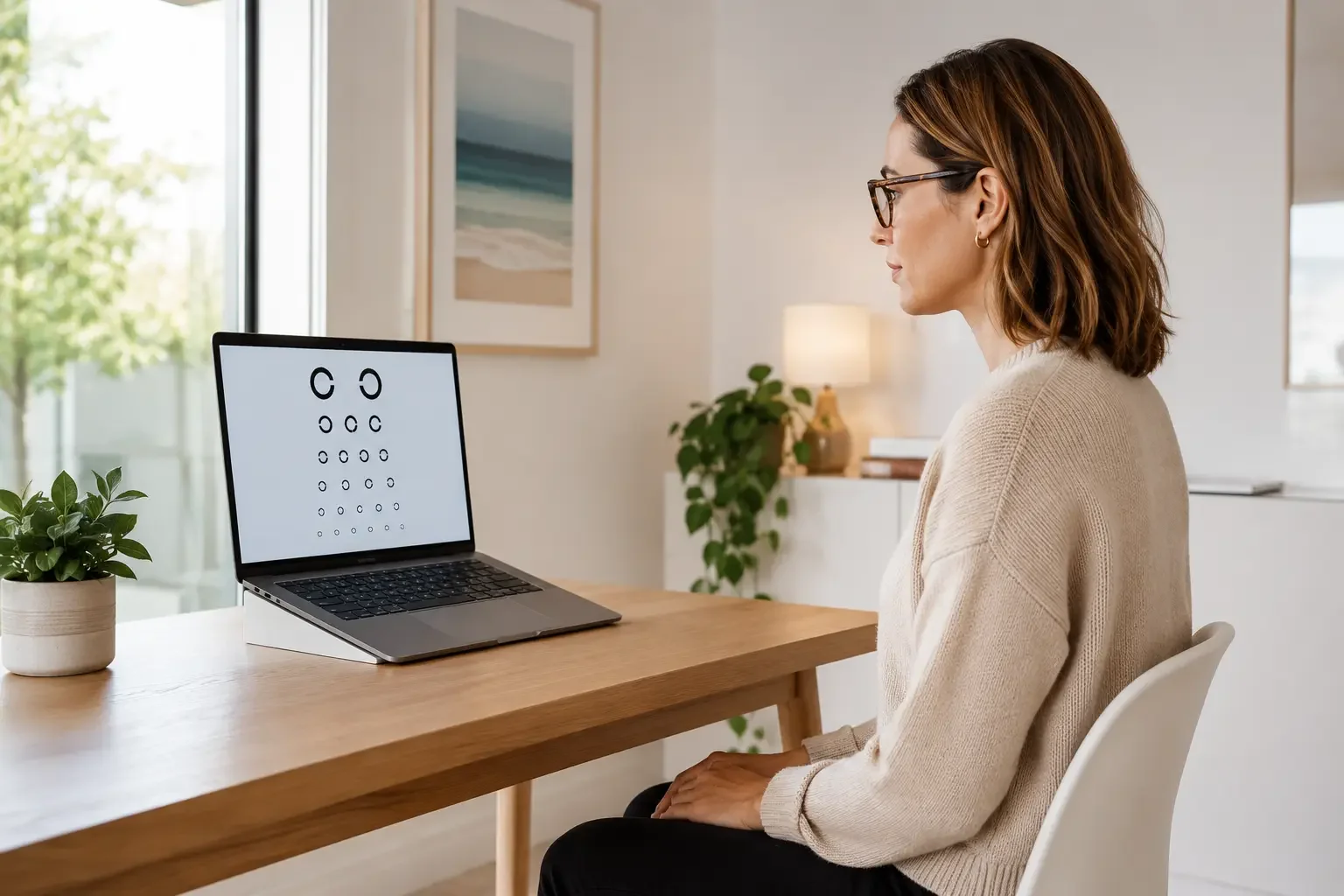
If you want to use an online vision test as a preliminary check, improve the reliability of the result by following these steps:
Use the device recommended by the test.
Read the calibration instructions carefully.
Sit at the specified distance.
Keep the screen directly in front of you.
Use consistent lighting.
Reduce screen glare.
Test each eye separately if instructed.
Don't deliberately guess answers.
Follow the instructions about wearing or removing glasses.
Repeat the test if the result seems unusual.
Compare results over time rather than relying on one isolated reading.
Arrange a professional examination if your vision has changed.
An online result should be treated as information, not a diagnosis.
Can Online Eye Tests Detect Short-Sightedness?
They can help identify reduced distance visual acuity that may be consistent with short-sightedness.
Myopia causes distant objects to appear blurred, and an eye chart can demonstrate reduced distance vision.
However, a comprehensive examination is still useful for determining the cause and appropriate correction. Healthdirect recommends seeing an optometrist if you or your child may be short-sighted.
If you're researching new frames after discovering that you need vision correction, explore the latest Eyewear Trends for inspiration on styles, frame shapes and Australian eyewear trends.
What About Astigmatism?
Astigmatism occurs when the eye's optical system does not focus light evenly.
People may experience:
Blurred vision
Difficulty focusing
Headaches
Squinting
Difficulty seeing at night
Eye strain
An online visual-acuity test might identify reduced clarity, but it generally cannot provide the same clinical assessment of astigmatism as an optometrist.
Healthdirect specifically recommends an eye examination for diagnosis.
Are Online Eye Tests Safe for Older Australians?
Older adults should be particularly cautious about using an online test as their only form of eye care.
Age increases the risk of several eye conditions, and some may progress before noticeable symptoms become severe.
Healthdirect recommends regular eye examinations even when there are no obvious symptoms. Its current guidance states that people under 65 should generally have eye tests every 2 to 3 years, while people 65 and older should have them annually, with more frequent assessment where risk factors or clinical needs exist.
Medicare's current MBS structure also distinguishes comprehensive optometry consultations by age and eligibility, with item 10910 applying to eligible patients under 65 and item 10911 to eligible patients aged 65 or older at specified intervals.
What Australians Should Know About Medicare and Eye Tests
One reason Australians may search for online eye tests is cost or convenience.
But an online test should not automatically be considered the cheaper replacement for professional eye care.
Eligible Australians may receive Medicare benefits for optometry services, subject to the applicable MBS rules and service intervals. Healthdirect says Medicare rebates may apply to optometrist eye tests and recommends checking fees and bulk-billing arrangements with the practice.
For example, the current MBS lists item 10910 for eligible patients under 65 and item 10911 for eligible patients aged 65 or over, with different service intervals.
Important: Medicare eligibility and billing rules can change, so check the current MBS and confirm costs with your optometrist before your appointment.
How Do You Know If an Australian Optometrist Is Legitimate?
If you're booking an eye examination, you can check whether the practitioner is registered.
The Australian Health Practitioner Regulation Agency (Ahpra) maintains the national register of health practitioners, including optometrists.
This is a useful step that many online articles overlook.
You can search the register by practitioner name, profession, location or registration number.
Check the Australian health practitioner register
If you are looking for an optometrist in Australia, LocalEyez can also help you explore Australian eye-care providers and local options.
When Should You Skip the Online Eye Test?
There are situations where an online screening test should not be your next step.
See an optometrist or seek appropriate medical care if you have:
A noticeable change in vision
Persistent blurred vision
Double vision
Eye pain
Redness or swelling
Difficulty seeing at night
Frequent headaches associated with vision
New difficulty reading
New problems with colour vision
Sudden changes in one eye
New or worsening floaters
Healthdirect advises seeking prompt medical attention for symptoms such as flashing lights, severe eye pain or significant changes in vision.
Some symptoms are emergencies
Sudden flashes, a sudden increase in floaters, or a dark curtain or shadow moving across your vision can be symptoms of retinal detachment.
Retinal detachment is a medical emergency because delayed treatment can result in permanent vision loss.
Do not spend time repeating online eye tests if you have sudden or severe vision changes. Seek urgent medical attention.
Can an Online Eye Test Replace an Optometrist?
No — not for comprehensive eye care.
The better way to think about online testing is as an additional tool.
Online test = screening
It may help answer:
"Has my vision changed enough that I should investigate it?"
Professional eye examination = clinical assessment
It helps answer:
"What is causing the change, what prescription do I need, and are there signs of an eye-health problem?"
That distinction is the key to using online eye tests safely.
What Online Eye Tests Are Actually Good For
Online testing can be particularly useful for:
Quick vision screening
If you're curious about your current visual acuity, a validated online test can provide a useful snapshot.
Monitoring changes
If you're already under professional care, digital testing may help monitor changes between appointments when recommended by your care team.
Accessibility
Digital tests can be useful for people who have difficulty immediately reaching an eye-care provider.
Telehealth
Research into teleophthalmology increasingly supports the potential of remote technologies. A 2024 systematic review covering 12 studies and 3,539 participants found that home and remote OCT systems could achieve high-quality imaging and strong agreement with in-office OCT for several applications, although results varied between conditions and technologies.
This is an important distinction: advanced teleophthalmology involving specialist-grade imaging is very different from a basic online eye chart.
What Are the Biggest Problems With Online Eye Tests?
The biggest weakness isn't necessarily the digital technology itself.
It's what the technology cannot see.
A computer screen cannot independently tell you whether your blurry vision comes from a simple refractive error or an underlying eye-health problem.
And even when an online visual-acuity test is validated, research typically validates a specific test under specific conditions — not every generic eye-test website on the internet.
This is why Australians should look beyond claims such as "99% accurate" and ask:
Has the test been clinically validated?
What exactly does it measure?
Was it compared with a recognised clinical standard?
Does it calibrate screen size and testing distance?
Does it test one eye at a time?
Who developed the technology?
Is the test intended for screening or diagnosis?
What happens if the result is abnormal?
Does the provider clearly explain its limitations?
Those questions are far more useful than simply asking whether an online eye test is "accurate."
The Smartest Way to Use an Online Eye Test
Think of an online eye test as the smoke alarm, not the fire brigade.
It can alert you that something may need attention.
But if the result is abnormal, or your eyes are producing symptoms, the next step should be professional assessment.
For Australians, a practical approach is:
Step 1: Use a reputable, properly designed online screening tool if you want a quick preliminary check.
Step 2: Follow the test's calibration and distance instructions carefully.
Step 3: Don't interpret a normal result as proof that your eyes are disease-free.
Step 4: Arrange an optometrist appointment if your vision has changed or the result concerns you.
Step 5: Seek urgent care for sudden or severe vision changes.
Step 6: Continue regular professional eye examinations even if your online results look normal.
Read More
If you're wondering whether it's time for a professional eye examination, read Signs You Need an Eye Test to learn about common warning signs and changes in vision that shouldn't be ignored.
Looking for local options? Explore Eye Care Clinics in Sydney to learn more about finding eye-care services in Sydney.
Final Verdict: Are Online Eye Tests Accurate?
Yes, online eye tests can be accurate enough for certain types of visual-acuity screening — but no, they should not be considered a complete replacement for an optometrist examination.
Scientific studies have demonstrated that validated smartphone, website and home-based visual-acuity tests can produce results reasonably close to standard clinical measurements.
But accuracy depends on the test, device, calibration, viewing distance and user. More importantly, a basic online test cannot perform the full clinical assessment needed to evaluate overall eye health.
For Australians, the safest approach is simple:
Use online eye tests as a convenient screening or monitoring tool, not as a substitute for professional eye care.
If your vision has changed, you have persistent symptoms or you have risk factors for eye disease, book an examination with a registered optometrist.
Your eyes deserve more than a yes-or-no result on a screen.
Frequently Asked Questions
Are online eye tests accurate in Australia?
Some validated online visual-acuity tests can provide results comparable to clinical measurements, particularly when the test is properly calibrated and performed according to instructions. However, accuracy varies between platforms, and online screening should not replace a comprehensive eye examination.
Can an online eye test tell me my glasses prescription?
Some services may attempt to estimate or support prescription-related measurements, but a basic online vision test is not equivalent to a professional refraction. If your prescription has changed or you have new symptoms, see an optometrist.
Can an online eye test detect glaucoma?
A basic online vision test cannot reliably rule out glaucoma. Glaucoma can develop without obvious symptoms, which is one reason regular professional eye examinations are important.
Can I use an online eye test instead of seeing an optometrist?
No. An online test can be useful as a preliminary screening tool, but it cannot replace comprehensive professional eye care.
Are online eye tests safe for children?
Online visual-acuity tools can have a role in screening, and research has shown promising results with validated smartphone testing. However, accuracy can decline in children with poorer vision, and children should still receive appropriate professional eye examinations.
How often should Australians have an eye test?
Healthdirect recommends regular optometrist eye tests, generally every 2 to 3 years for people under 65 and annually for people aged 65 or older, with more frequent testing where risk factors or clinical needs exist.
Can an online eye test detect astigmatism?
It may identify reduced visual clarity associated with astigmatism, but diagnosing astigmatism requires an appropriate eye examination.
Why are online eye test results different on my phone and computer?
Screen size, brightness, resolution, viewing distance and calibration can influence results. Research has shown that device and screen conditions can affect online visual-acuity measurements.
Should I take an online eye test if I have sudden blurry vision?
No. Sudden vision changes should be assessed promptly rather than relying on an online screening tool. Sudden flashes, a major increase in floaters, a dark curtain or shadow, severe eye pain or sudden vision loss can require urgent medical attention.
Can I get an eye test through Medicare in Australia?
Eligible patients may receive Medicare benefits for optometry services, subject to current Medicare Benefits Schedule rules and applicable service intervals. Healthdirect advises checking with the optometrist about fees and whether they bulk bill.
How can I find a registered optometrist in Australia?
Ahpra maintains Australia's national register of registered health practitioners, including optometrists. You can search the register to check a practitioner's registration status.
Is an online eye test the same as teleophthalmology?
No. A basic online eye chart is very different from teleophthalmology systems that may use specialist imaging such as OCT and remote clinical interpretation. Research into home and remote OCT shows promising diagnostic potential, but these technologies are more sophisticated than ordinary online vision tests.