
How Do Multifocal and Bifocal Contact Lenses Work? (Complete Guide)
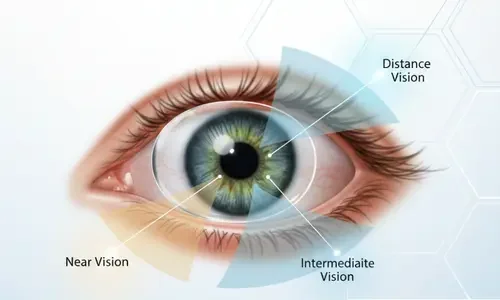
If you’re over 40 and finding it harder to read menus, texts, or your laptop screen, you’re not alone. Age-related near vision changes — called presbyopia — are completely normal.
The good news? You don’t have to switch between reading glasses and regular glasses anymore.
Multifocal and bifocal contact lenses are specially designed to help you see clearly at multiple distances — near, intermediate, and far — all in one lens.
In this guide, we’ll explain:
How multifocal contact lenses work
How bifocal contact lenses work
The difference between the two
Pros and cons
FAQs for better understanding
What Is Presbyopia?
Presbyopia is a natural condition that typically begins after age 40. The eye’s lens becomes less flexible, making it difficult to focus on close objects.
Common symptoms:
Holding your phone farther away to read
Eye strain while using a computer
Difficulty reading small print
Headaches after close-up tasks
Multifocal and bifocal contact lenses are designed specifically to correct this issue.
How Do Multifocal Contact Lenses Work?
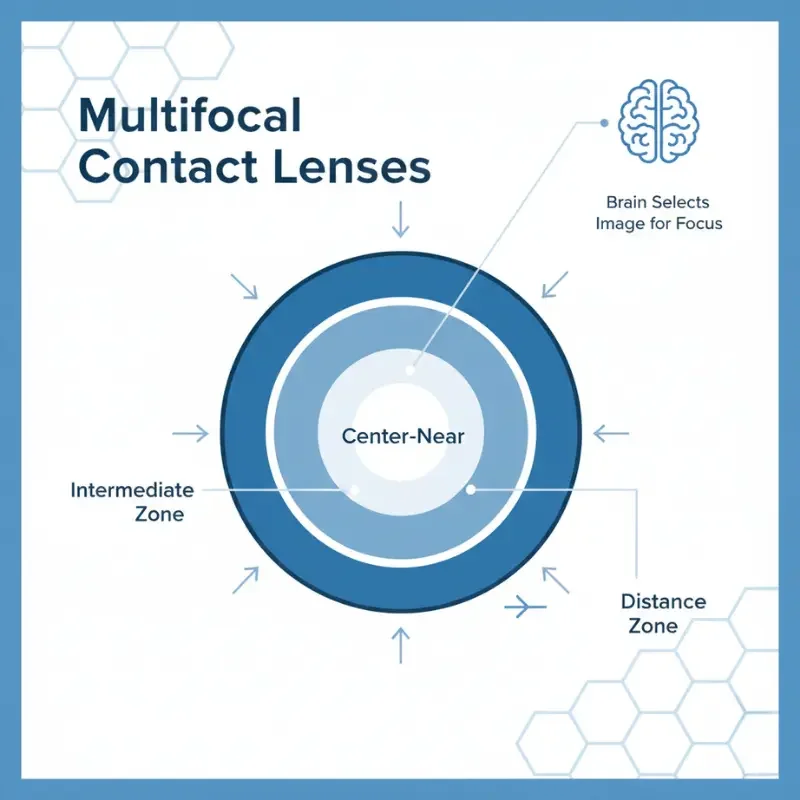
Multifocal contact lenses work by combining multiple prescription powers into a single lens. They allow your eyes to focus at near, intermediate, and far distances by using specially designed optical zones that your brain naturally adjusts to.
Types of Multifocal Contact Lens Designs
1. Simultaneous Vision Design
In this design, multiple prescriptions are present in the lens at the same time. Light from near and distant objects enters the eye simultaneously, and your brain selects the image it needs.
There are two main structures:
Center-near design (near vision in the middle)
Center-distance design (distance vision in the middle)
Your optometrist chooses the right type based on your lifestyle.
2. Concentric Ring Design
These lenses have alternating rings of near and distance power — similar to a target pattern.
Your pupil size determines which power is being used more prominently at any given time.
3. Aspheric Design
Aspheric multifocal lenses gradually change power from the center outward, offering a smoother transition between distances.
They are often preferred for:
Computer users
Professionals
People who need sharp intermediate vision
Read Also: How to Read Your Glasses & Contact Lens
How Do Bifocal Contact Lenses Work?
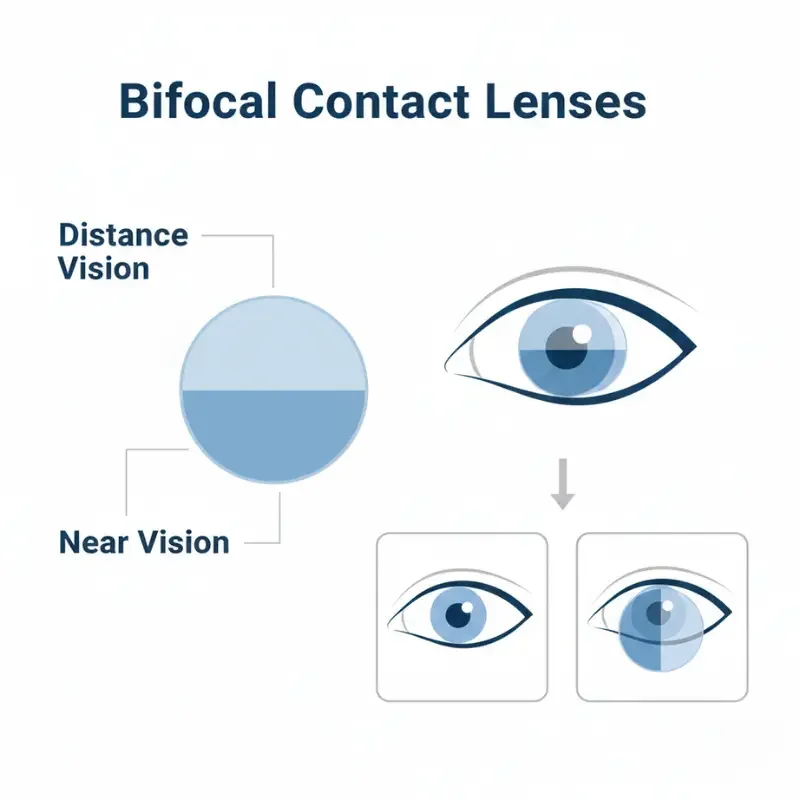
Bifocal contact lenses contain two distinct optical powers — one for distance and one for near vision. They are designed either in segmented sections or simultaneous vision formats to help correct presbyopia.
Suggested Read: Bio-Acetate Sunglasses
Types of Bifocal Contact Lenses
1. Segmented (Translating) Bifocals
These lenses work similarly to bifocal glasses.
Bottom portion = Near vision
Upper portion = Distance vision
When you look down, the lens shifts slightly so you can see clearly up close.
These are usually rigid gas permeable (RGP) lenses.
2. Simultaneous Vision Bifocals
Similar to multifocals, both prescriptions are available at once. Your brain learns to prioritize the correct image.
Multifocal vs Bifocal Contact Lenses: What’s the Difference?
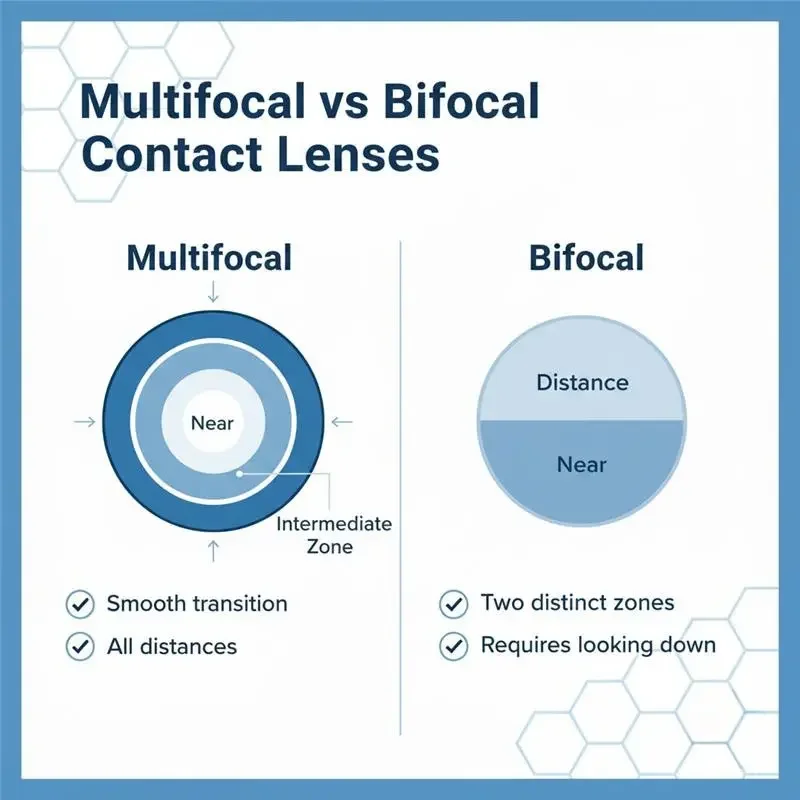
| Feature | Multifocal | Bifocal |
|---|---|---|
| Number of Powers | 2 or more | 2 |
| Intermediate Vision | Yes | Limited |
| Adaptation Time | Moderate | Moderate |
| Comfort | Soft lens options widely available | Often RGP for segmented type |
| Best For | Active lifestyles, screen users | Clear separation of near & far |
In simple terms: Multifocal lenses provide smoother transitions between distances, while bifocals separate near and distance more distinctly.
Advantages of Multifocal & Bifocal Contact Lenses
✔ No need for reading glasses
✔ Natural field of vision
✔ Better aesthetics (no visible lines)
✔ Convenient for active lifestyles
✔ Improved computer and phone use
Are There Any Downsides?
Some users may experience:
Slight glare at night
Reduced contrast sensitivity
Adjustment period (1–2 weeks)
Trial and fitting time needed
A professional fitting is essential for best results.
Who Is a Good Candidate?
You may benefit from multifocal or bifocal contact lenses if:
You’re over 40
You have presbyopia
You want freedom from reading glasses
You use screens frequently
You live an active lifestyle
Tips for Better Adaptation
Wear them consistently during the adaptation phase
Follow your optometrist’s instructions
Attend follow-up appointments
Ensure correct lens cleaning and care
Final Thoughts
Multifocal and bifocal contact lenses are innovative solutions for presbyopia, offering clear vision at multiple distances without switching glasses.
The right choice depends on:
Your prescription
Your daily activities
Your comfort preference
Professional fitting recommendations
If you’re experiencing difficulty reading or focusing on nearby objects, consult an eye care professional to explore your options.
Frequently Asked Questions (FAQ)
1. Are multifocal contact lenses hard to adjust to?
Most people adapt within 1–2 weeks. The brain learns to select the appropriate focus automatically.
2. Do multifocal lenses work for computer use?
Yes. Aspheric and center-near designs are particularly effective for intermediate vision.
3. Are bifocal contact lenses better than multifocal?
It depends on your needs. Multifocals provide smoother vision transitions, while bifocals offer clearer separation between near and far.
4. Can I drive at night with multifocal lenses?
Yes, but some people may experience mild halos or glare initially.
5. Do they cost more than regular contact lenses?
Yes, multifocal and bifocal lenses typically cost more due to their advanced design.