
Contact Lenses Types: A Simple Guide to Choosing the Right Lens
The main types of contact lenses are soft, rigid gas permeable (RGP), daily disposable, planned-replacement, toric, multifocal, hybrid, scleral, Ortho-K and coloured/decorative lenses. Soft lenses are generally easier to adapt to, while RGP lenses can provide crisp vision and are useful for some people with irregular corneas. Toric lenses correct astigmatism, while multifocal lenses help with both near and distance vision. The best lens depends on your prescription, eye health and lifestyle.
Contact Lenses Types: Which One Is Right for You?
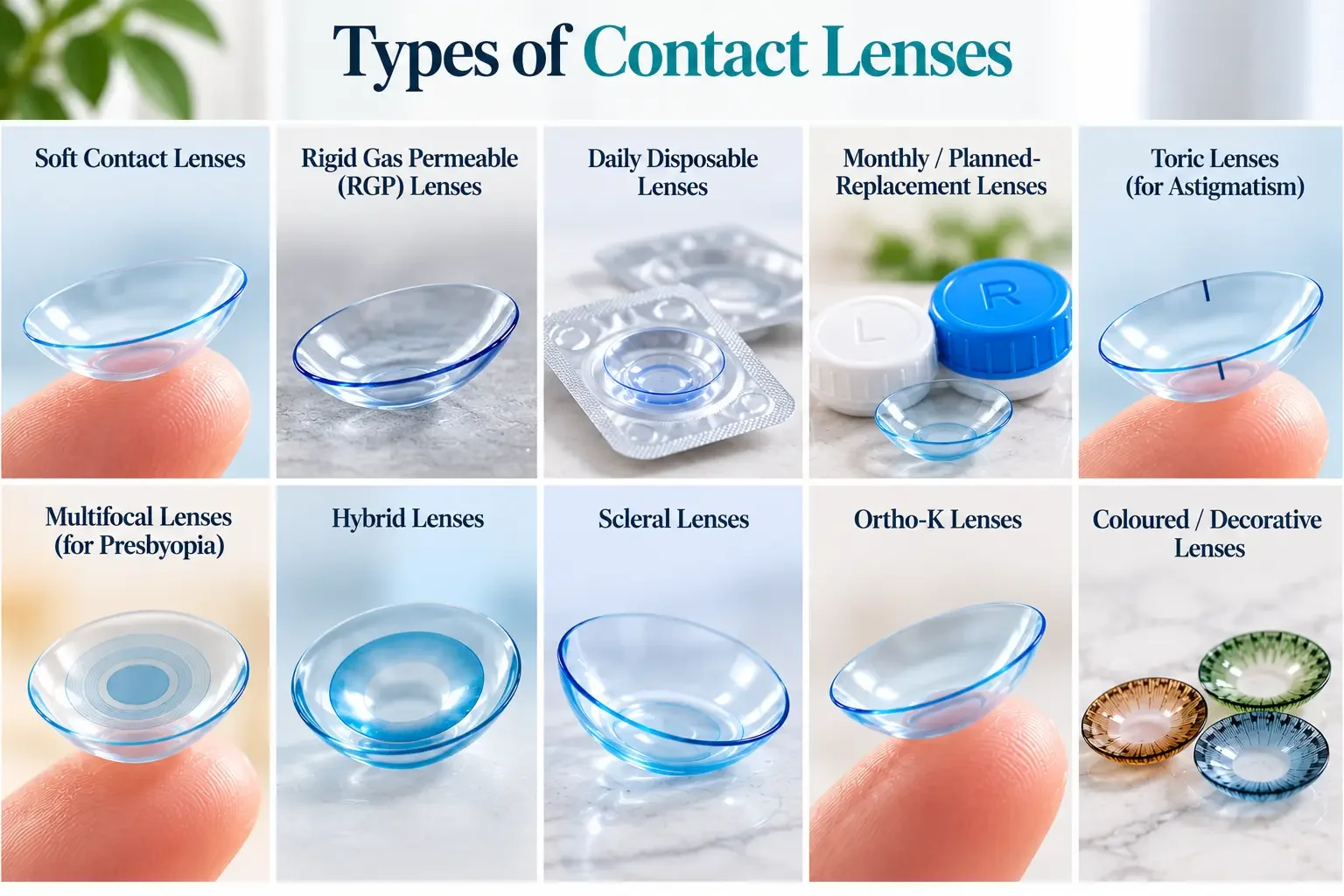
Contact lenses aren't one-size-fits-all. The right type depends on your vision prescription, eye shape, eye health, wearing habits and lifestyle.
The easiest way to understand contact lenses is to look at them from three angles:
Material: soft or rigid gas permeable (RGP)
Vision correction: spherical, toric or multifocal
Replacement/wearing schedule: daily disposable, fortnightly/monthly or extended wear
There are also specialised lenses such as hybrid, scleral, Ortho-K and coloured contacts.
All contact lenses require proper fitting and a prescription from an eye-care professional.
1. Soft Contact Lenses
Soft lenses are flexible lenses that sit comfortably over the cornea and are the most commonly worn type.
They are available in materials including hydrogel and silicone hydrogel, with silicone hydrogel allowing high oxygen transmission.
Best for:
Everyday wearers, first-time contact lens users and people who prioritise comfort.
Advantages:
Comfortable for most new wearers
Easy to adapt to
Available in many prescriptions
Available as daily, fortnightly/monthly and other replacement schedules
2. Rigid Gas Permeable (RGP) Lenses
RGP lenses are firmer than soft lenses but allow oxygen to reach the cornea.
They can provide sharp, crisp vision and may be particularly useful for people with astigmatism or irregular corneas, including keratoconus.
Best for:
People who need precise vision correction or have certain corneal conditions.
Consider:
They can take longer to adapt to than soft lenses and require consistent wear for comfort.
3. Daily Disposable Contact Lenses
Daily disposable lenses are worn once and discarded at the end of the day.
They are different from lenses that are simply worn during the day but reused for several weeks.
Best for:
People who want a fresh pair every day, occasional wearers, travellers or those who prefer minimal lens maintenance.
Main benefit:
No overnight storage or daily lens cleaning is required.
4. Monthly and Planned-Replacement Lenses
These lenses are designed to be removed, cleaned and reused according to their specific replacement schedule.
Depending on the lens, replacement periods can range from around one week to several weeks or longer. Never extend the schedule simply because a lens still looks usable.
Best for:
Regular contact lens wearers who are comfortable following a cleaning and replacement routine.
5. Toric Contact Lenses for Astigmatism
Toric lenses are specially designed to correct astigmatism.
Unlike standard spherical lenses, they have different optical powers across the lens and need to remain correctly positioned on the eye.
Best for:
People with astigmatism who want contact-lens vision correction.
Toric lenses are available in both soft and other specialised designs.
6. Multifocal Contact Lenses
Multifocal lenses are designed to provide vision at different distances, making them a popular option for people with presbyopia.
They can help with:
Distance vision
Intermediate vision
Reading and close work
Lens designs vary, so your optometrist may recommend a particular design based on your vision requirements and lifestyle.
Learn more: How Do Multifocal and Bifocal Contact Lenses Work?
7. Hybrid Contact Lenses
Hybrid lenses combine a rigid gas-permeable centre with a softer outer portion.
The idea is to combine the optical clarity of an RGP lens with some of the comfort and stability associated with soft lenses. They can be useful for people with irregular corneas.
Best for:
Certain patients who need sharper vision but find traditional RGP lenses difficult to tolerate.
8. Scleral Contact Lenses
Scleral lenses are larger than conventional contact lenses and rest mainly on the white part of the eye rather than the cornea.
They are specialty lenses often used for irregular corneas and particular ocular surface problems.
Best for:
People who need specialty vision correction or have corneal irregularities.
These lenses require specialised fitting by an appropriately trained eye-care professional.
9. Ortho-K Contact Lenses
Orthokeratology, commonly called Ortho-K, uses specially designed rigid lenses that are typically worn while sleeping.
They temporarily reshape the cornea so vision can be clearer during the day without wearing conventional contacts or glasses.
Best for:
Selected patients who are suitable candidates for overnight corneal reshaping.
Ortho-K requires professional assessment and ongoing monitoring.
10. Coloured and Decorative Contact Lenses
Coloured contacts can change or enhance your natural eye colour. Some also contain vision correction, while others are purely cosmetic.
But “cosmetic” does not mean risk-free. Decorative contact lenses still need proper fitting and a prescription because an incorrectly fitted lens can injure the eye or increase the risk of complications.
Best for:
People wanting to change their eye appearance, provided the lenses are professionally fitted and obtained from an authorised source.
Related: Ultimate Guide to Coloured Lenses in Australia
Which Type of Contact Lens Is Best for You?
| Your Need | Contact Lens Type to Discuss |
|---|---|
| First-time wearer | Soft lenses |
| Everyday convenience | Daily disposables |
| Regular reusable wear | Planned-replacement lenses |
| Astigmatism | Toric lenses |
| Presbyopia | Multifocal lenses |
| Very crisp vision | RGP lenses |
| Irregular cornea | RGP, hybrid or scleral lenses |
| Corneal reshaping | Ortho-K |
| Change eye colour | Coloured lenses |
Important: This table is a starting point, not a prescription. Your optometrist needs to assess your eyes and determine the appropriate lens, fit and wearing schedule.
What Should You Consider Before Choosing Contact Lenses?
Don't choose contacts based only on price or comfort. Consider:
Your prescription
Your contact lens prescription can contain different information from your glasses prescription because contacts sit directly on the eye.
Read: How to Read Your Glasses & Contact Lens Prescription
Your lifestyle
Sports, long working hours, travel and frequent outdoor activities can influence which lens design and replacement schedule is practical.
Dry or sensitive eyes
If your eyes frequently feel dry or irritated, tell your optometrist before choosing a lens. Material, wearing time and lens design can all matter.
How often you want to wear contacts
Someone wearing contacts occasionally may prefer daily disposables, while a frequent wearer may prefer a planned-replacement option.
Your ability to maintain lenses
Reusable lenses require proper cleaning, disinfection and storage. Never reuse a lens beyond its recommended schedule.
Daily vs Monthly Contact Lenses: Which Is Better?
Daily disposables offer convenience because you use a fresh pair each day and don't need to store lenses overnight.
Monthly or planned-replacement lenses can be practical for regular wearers but require consistent cleaning and correct storage.
Neither is automatically “better” for everyone. The right choice depends on your eyes, prescription, wearing frequency and ability to follow the care routine.
Can You Sleep in Contact Lenses?
Not all contact lenses are approved for overnight wear.
Some extended-wear lenses are specifically designed and approved for longer continuous wear, but overnight wear should only happen when your eye-care professional has confirmed that the specific lens and schedule are appropriate for you.
For ordinary daily-wear lenses, remove them before sleeping or napping.
How Do You Know Which Contact Lenses You Need?
The safest way is through a contact lens examination and fitting.
An eye-care professional can:
Check your eye health.
Measure and assess how the lens fits.
Determine your vision correction.
Recommend a suitable lens material and design.
Explain wearing, cleaning and replacement requirements.
If you're looking for professional eye care, you can also find an optometrist in Australia.
FAQs About Contact Lens Types
1. What are the main types of contact lenses?
The main types include soft, RGP, daily disposable, planned-replacement, toric, multifocal, hybrid, scleral, Ortho-K and coloured contact lenses.
2. Which contact lenses are best for beginners?
Soft lenses, particularly daily disposable lenses, are often easier for new wearers to adapt to. However, the best option depends on your prescription and eye health.
3. What type of contact lenses is best for astigmatism?
Toric contact lenses are specifically designed to correct astigmatism. Some people may also benefit from RGP or specialty lenses depending on their corneal shape.
4. Are daily or monthly contact lenses better?
Daily lenses are simpler because they are discarded after use. Monthly lenses can be suitable for regular wearers who can maintain the required cleaning and replacement routine. Your optometrist can recommend the better option for your eyes and lifestyle.
5. Can I buy coloured contact lenses without a prescription?
You should not treat coloured or decorative contacts as ordinary cosmetics. They require proper fitting and prescription oversight because poorly fitted lenses can cause eye injury and complications.
Final Takeaway
There isn't one “best” type of contact lens. Daily disposables may suit convenience-focused wearers, toric lenses can correct astigmatism, multifocals can address presbyopia, RGP and specialty lenses can help with more complex corneal needs, and coloured lenses can change appearance.
The important question isn't “Which contact lens is most popular?” but “Which lens is properly fitted for my eyes, prescription and lifestyle?”
For safe, comfortable wear, have your lenses fitted by an optometrist and follow the recommended wearing, cleaning and replacement schedule.